 At the turn of the century there lived a celebrated phenomenon of a horse, General Hans, or Clever Hans as he was popularly known. The reason for his fame was exhibitions of his amazing capacity to perform taxing arithmetic and other intellectual tasks at shows around Germany. Hans had quite a substantial resume; communicating by tapping the ground with his hoof, he could read, spell, add, multiply and subtract, as well as being able to differentiate various musical tones and even understand German. Whilst there were many theories offered to explain Han’s extraordinary abilities, it was later discovered that the horse was no paradox but rather part of an elaborate hoax orchestrated by his owner, a mathematics teacher and amateur equine trainer. The feat was accomplished by training Hans to respond to his owner’s subtle cues in body language, no small achievement in itself.
With this delightful story, Carl Bronner, originator of the unique and fascinating “Horseplay” sessions currently on offer in the Dargle, introduced the mornings guests to the first of many Midlands experiences that they were to enjoy over the following 2 days of their “Meandering the Midlands” cycle tour.
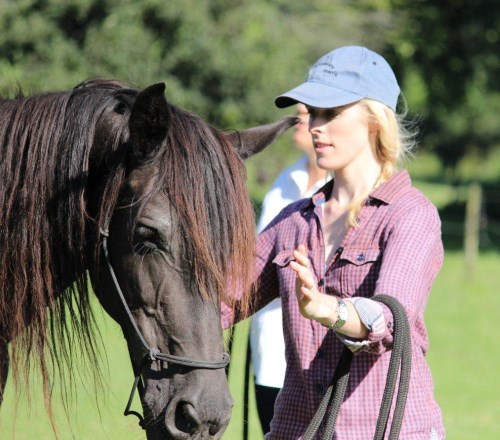
“Today, you are going to learn to communicate across the species barrier” stated Carl as our two timid German guests, Simone and Christiano, stood alongside their beautiful black Dutch Friesan horses set against the backdrop of green pastures and mist belt forest. Traditionally it has been accepted that horses need to be “broken in” in order to subdue their spirit and establish dominance over them. Carl Bronner, the owner of Kilgobbin and Horseplay, has been working with horses for the past 20 years. She believes that there are better ways to achieve a similar end, rather nurturing a relationship based on mutual respect and harmony between man and horse.
In order to understand the complex psychology and motivations of a horse we need to understand their place in the world. The first lesson of the day was to resist the impulse to boldly approach the horse and grasp it by its head with a halter. Being an animal vulnerable to predation, horses have evolved to outwit their predators with eyes centered on the side of their head for maximal peripheral vision. When we grab a horse head first, we are copying the behavior of their predators and it is little wonder they turn tail and flee for the hills. Horses are accustomed to living in herds and feel secure when assured of their place in the pecking order by the gentle coercion of a trustworthy human. Their communication is subtle, a jostle of their hind quarters or a twitch of their ears is sufficient to make their messages understood, with personal boundaries, like ours, being well demarcated.
Armed with a new understanding and appreciation for these graceful creatures, our two German guests grew in understanding and confidence and started to really ease into the day. By the end of the morning Simone and Christiano were becoming quite adept at using their newly-learned body language cues to direct their horses to turn in circles, clamber over various large obstacles, and respect one another’s personal space. An experience like this was not just an instruction in horsemanship but also a valuable lesson in how we choose to communicate with other. Often we feel we need to force our opinion or aggressively deal with obstruction in order to be validated, while we forget that with respect, kindness and a little patience, anything is possible.
News supplied by Julia Colvin - www.spekboomtours.co.za