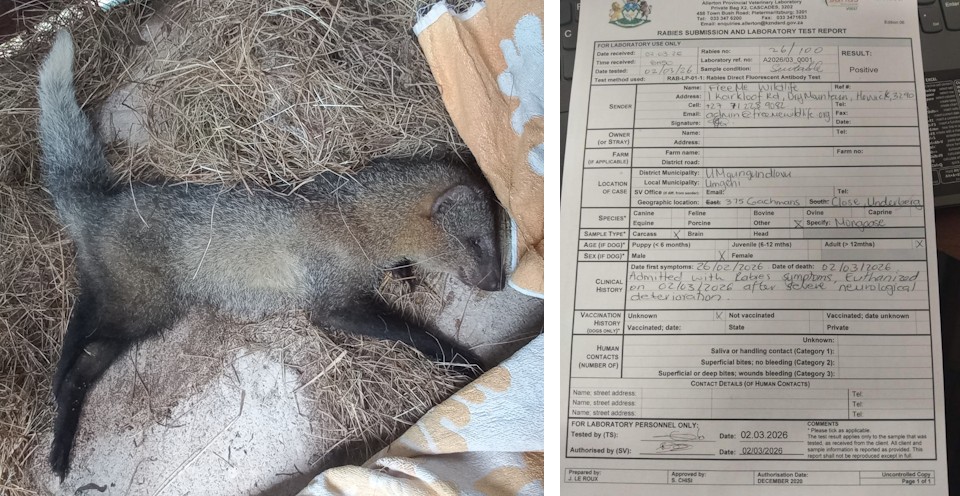
Rabies case confirmed.
This is a White-tailed Mongoose which contracted rabies in the Underberg region. A special thanks to all involved in reporting this case, and to Wildlife ACT - Focused Conservation for assisting in catching and transporting the animal through to FreeMe Wildlife.
After placing the Mongoose in quarantine and under constant observation, the animal steadily deteriorated to the point where it was severely neurologically incapacitated. At this point we decided to humanely euthanize the animal, thank you Dr Dave Gibbs for assisting, and sent it through to Allerton Veterinary Laboratories for rabies testing, which came back positive.
Be careful when dealing with wildlife (or any animal), that behaves abnormally.
Interesting info...
Canine rabies (rabies in domestic dogs) in South Africa has a history tied to introductions from outside the country, rather than originating natively in wildlife.
The earliest confirmed outbreak of canine rabies in South Africa occurred in 1893 in the Port Elizabeth area (now the Eastern Cape). It stemmed from an infected dog imported from England in 1892 (a Terrier shipped to the Cape Province). This led to an outbreak that was eventually controlled, but it marked the first documented introduction of the disease in domestic dogs.
Phylogenic studies show that current dog, Jackal, and related rabies viruses in southern Africa derive from this introduced canine-origin virus.
So... canine rabies did not originate in South Africa but was introduced multiple times - first in the late 19th century from Europe (England), and more enduringly in the mid-20th century from neighboring northern regions (Mozambique and across the Zambezi). These introductions, amplified by ecological and human factors like colonization and dog movements, established the endemic canine rabies seen today in parts of South Africa. Control efforts focus on dog vaccination to break transmission.
So think again before we blame wildlife for spreading this disease.
After euthanizing the White-tailed Mongoose, an adult male in his prime and had good body condition, the carcass was sent off for rabies testing to Allerton Veterinary Laboratories.
The result... positive.
A sad end to a beautiful creature, but everyday, we work with highs and lows in all we do at FreeMe Wildlife with the focus on inspiring an engaging and educated empathy for our wildlife and the environment.